
Findings from the workshop Circular plastics and advanced composites: collaboration, regulation and new business models are crucial
Plastics and composite materials pervade every aspect of our daily life, and there is an increasing push towards circularity to enhance their recyclability and reduce reliance on primary and fossil-based materials, while maintaining their versatility and advanced properties.
The end-of-life aspect of these materials is crucial:
- Plastic products with minimal mechanical requirements, such as single-use packaging, already have established collection and recycling pathways to minimise material loss. In some instances, biodegradable materials have substituted commodity plastics, allowing these products to be collected as biowaste and processed using biological waste treatment processes. However, single-use bioplastics can still end up in the environment, as they are litter-prone products.
- Composites offer enhanced mechanical, thermal and lightweight performances thanks to the versatility of different additives and can last for decades. However, since the significant challenges of separation and recycling of their components, the lack of European regulation for composites wastes (i.e. from time to time they are classified together with glass, plastics, etc.), composites mostly end up in thermal utilization or in landfills.
Thanks to the case studies of Return and REPOXYBLE projects, we explored the design and testing of compostable packaging materials and the development of depolymerizable epoxy systems suitable for use in the automotive and aerospace industries.
- Return conducted a systematic assessment of bioplastics biodegradability and associated ecotoxicological effects in diverse environments (compost, digestate, soil and seawater).
- REPOXYBLE presented a new circular design for high-performing recyclable composites, also moving towards a circular business model.
Closed synergies between research, industries and policy makers are the key for new sustainable and high-performing materials, effective waste management strategies, and circular business models.
In the following section, we present a summary of the key points that emerged from the discourse held with a group of 30 experts, researchers and practitioners specialising in waste collection and recycling. This discussion took place during the workshop entitled Circular plastics and advanced composites, which was organised in collaboration with our partner institution, BOKU University, as well as Return and REPOXYBLE. This event was held on the 14th of October 2025, and it was part of the SARDINIA 2025 – 20th International Symposium on Waste Management, Resource Recovery and Sustainable Landfilling.
Circularity of plastics: the need to increase production volumes and the role of regulations
We see a constant increase in Domestic Material Consumption (DMC)* per capita each year (+2,3%), with an even higher material environmental footprint.
* Domestic material consumption measures the total amount of materials directly used by an economy and is defined as the annual quantity of raw materials extracted from the domestic territory, plus all physical imports minus all physical exports. Source: Statistics Explained (https://ec.europa.eu/eurostat/statisticsexplained/) – 10/08/2023
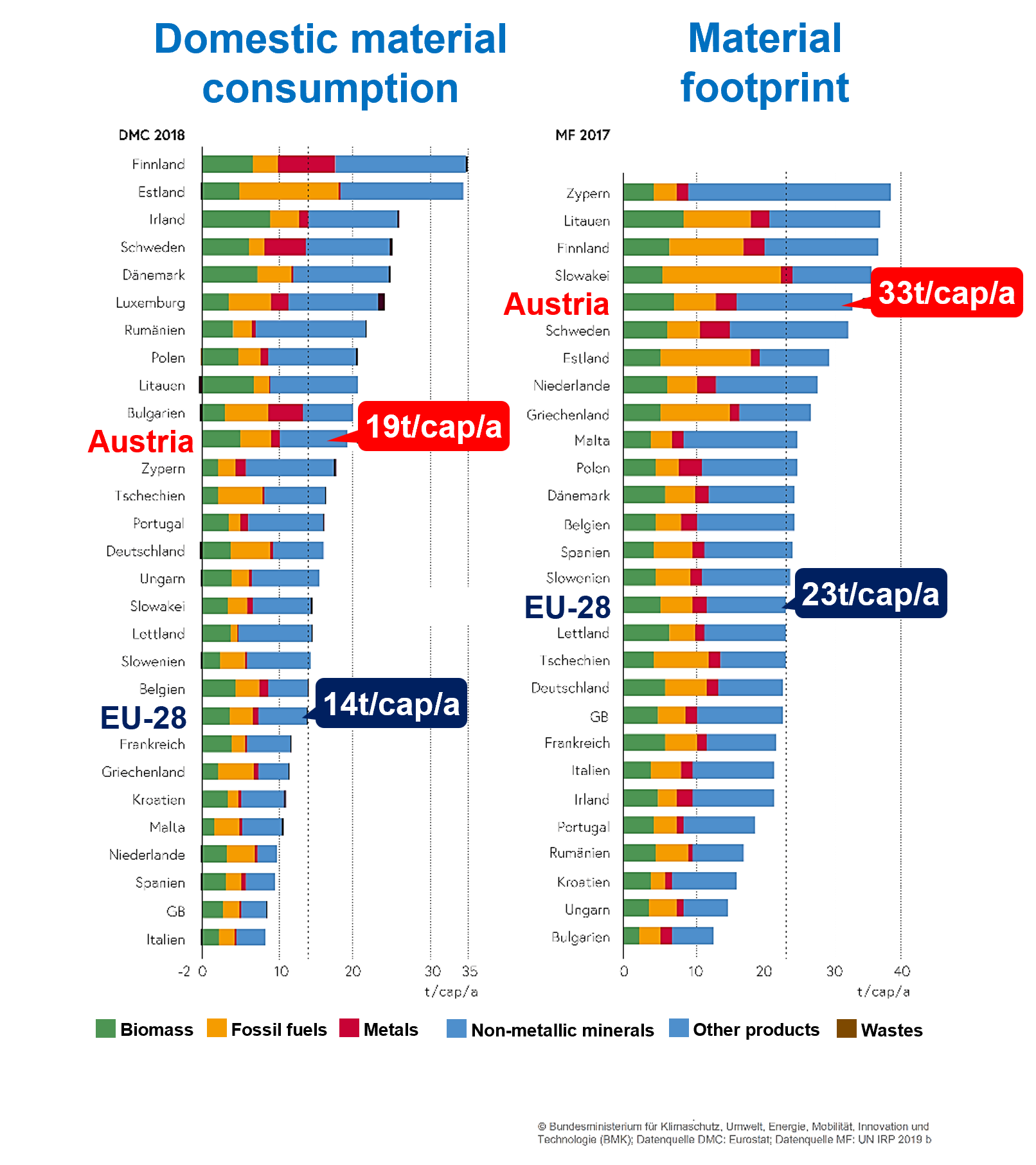
Domestic material consumption and material footprint, data adapted from Eurostat (for the DMC) and the UN IRP 2019 b for the material footprint by the Austrian BMK and modified by Part and Olscher.
Plastic production is increasing as well, with 400.3Mt reached in 2022, of which 14% produced by Europe. In this framework, circular plastics still cover a market niece: global post-consumer recycled plastics production reaches 35.5Mt, while bio-based & bio-attributed plastics is only 2.3Mt and the overall circularity rate is about 9,4%. Europe covers respectively 21% and 27% of these productions, with an overall 19,7% of circular plastics production: from mechanical recycling (post-consumer 13,2%, pre-consumer 5,4%), from bio-based & bio-attributed production (1%) and from chemical recycling (0,1%).
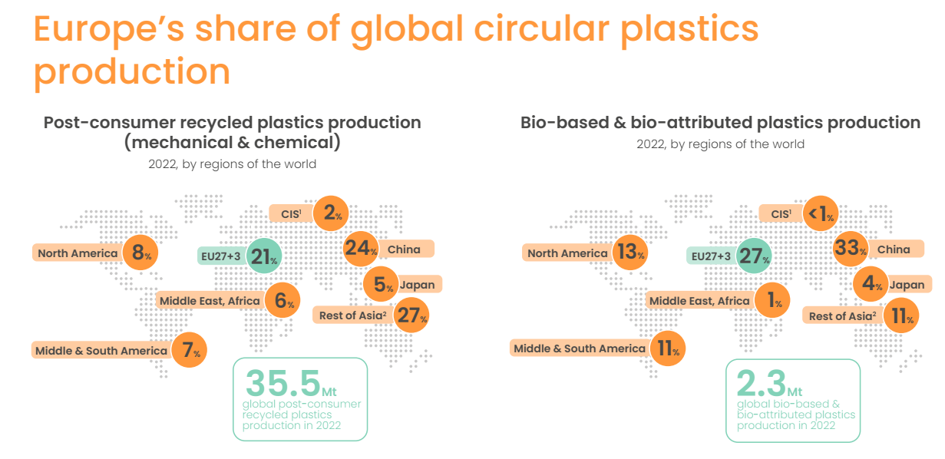
Source: The Circular Economy for Plastics – A European Analysis 2024, Plastic Europe (the report shows 2022 estimated data). https://plasticseurope.org/knowledge-hub/the-circular-economy-for-plastics-a-european-analysis-2024/
Innovation needs to move in accordance with concepts/principles of sustainability such as the Green Chemistry principles, ensuring new chemicals and formulations are not hazardous nor contain critical raw materials, while guaranteeing high energy efficiency and recyclability.
The Safe and Sustainable by Design (SSbD) framework which was developed and endorsed by the European Commission puts these principles into practice.
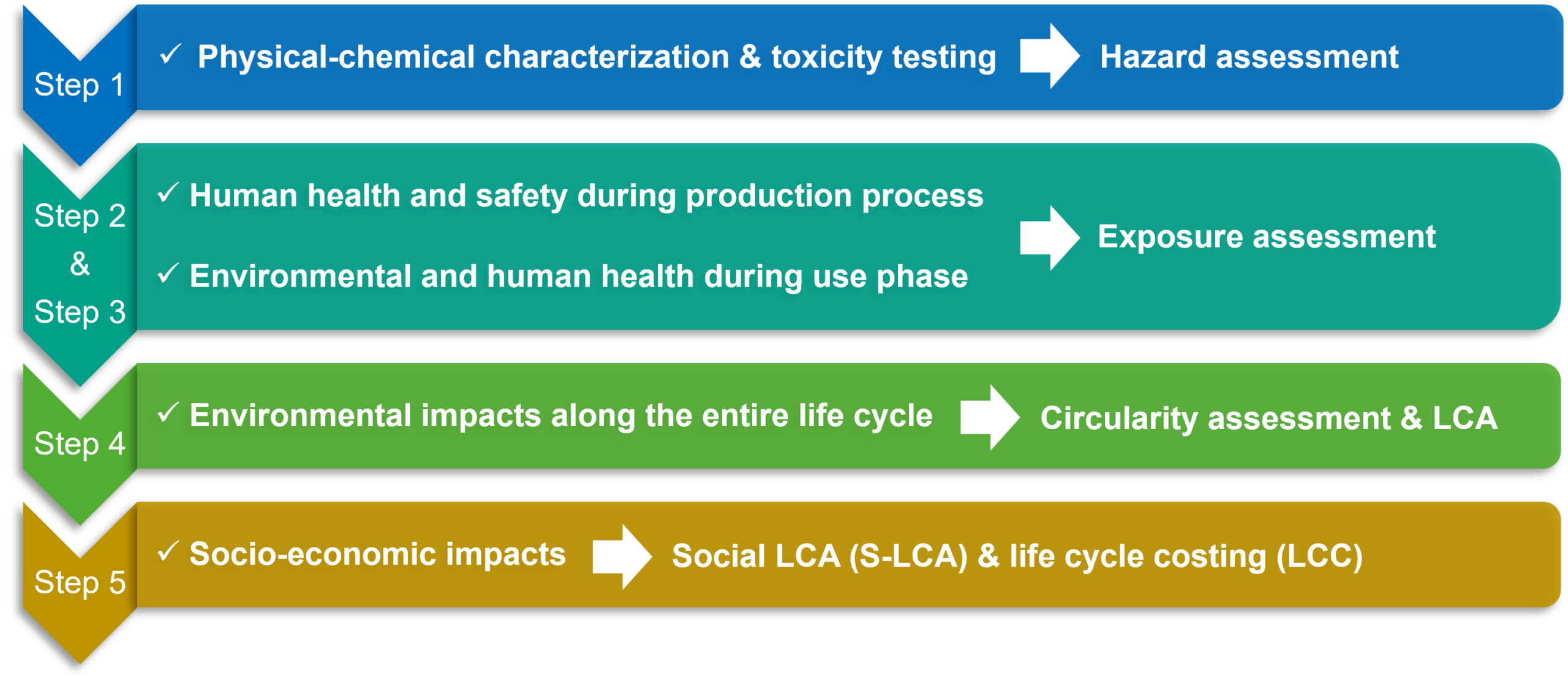
The five steps of the European Commission SSbD framework (in its first iteration).
Though, when applying these principles to different sectors the complexity increases. For example, the newly adopted European Packaging regulation states that all plastic packages must be recycled with certain exceptions that must be biodegradable (e.g. teabags, sticky labels on fruits and vegetables). This implies further certifications (Certification of compostable plastic compounds) and different tests in each Country.
As case studies of these principles and guidelines application, two projects that are declining sustainability in different sector were presented:
- Return, on the assessment of bioplastics biodegradability in different environmental conditions
- REPOXYBLE, on circular business concepts for new advanced polymer composites
Assessing sustainability: the RETURN study on bioplastics degradation
Biodegradable plastics, now everywhere in our daily lives, can be treated for material and energy recovery alongside the Organic Fraction of Municipal Solid Waste (OFMSW). However, concerns remain regarding the actual compatibility of bioplastic products with the existing waste treatment plants, as their degradation degree may not be satisfying and could compromise the quality of final compost/digestate. Moreover, their contamination potential when improperly littered into environmental compartments is still scientifically debated.
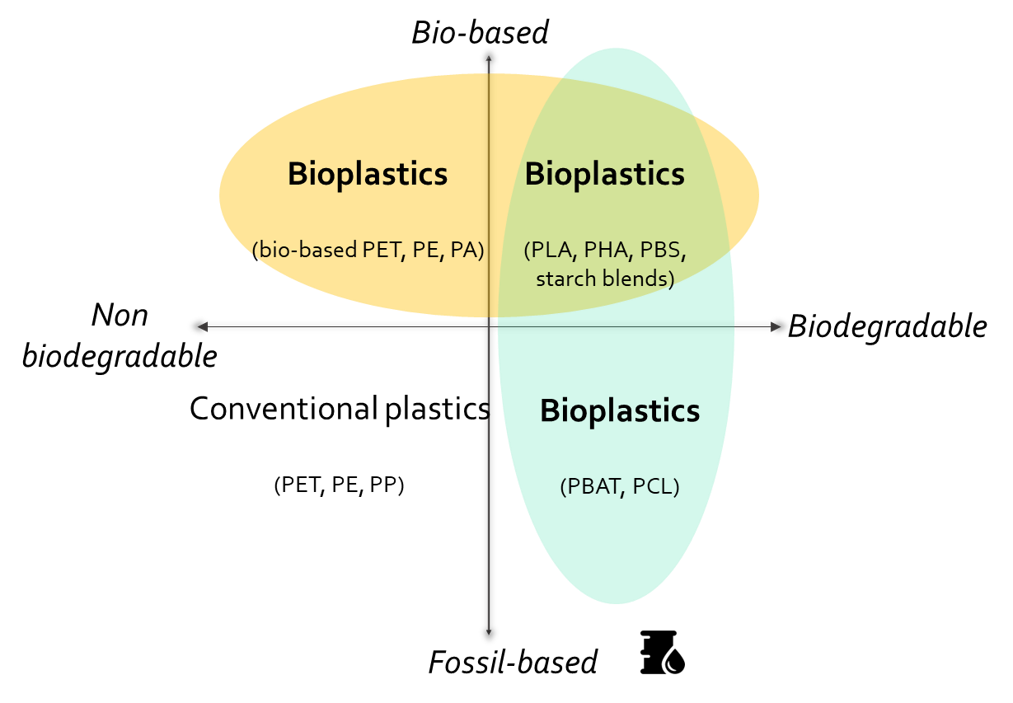
Plastic categories. Source: https://www.european-bioplastics.org/bioplastics/
There is a need to develop novel approaches and technologies for bioplastics treatment in existing waste management plants to deal with their complexity (e.g. bioplastic products usually are a blend of biopolymers and additives of different nature), as well as to define clear directives or regulations on bioplastic treatments.
We need to define optimal operating conditions for bioplastics without affecting the OFMSW treatment, and to assess the final compost/digestate quality to avoid turning it into a carrier of recalcitrant substances across the environmental compartments, like micro-bioplastics. Moreover, since bioplastics are mostly applied as single-use plastics and packaging, we need to study their potential contaminating effects when littered into the environment.
Here is where the Return project operates: applying innovative strategies, methods and models to understand, monitor, and assess environmental degradation and potential contaminating effects associated with bioplastics and their degradation products.
It examined the environmental fate and biodegradability of commercial EN 13432-compliant bioplastics (such as tableware, dental floss, coffee capsules, stickers and shoppers) under various conditions, simulating both aerobic and anaerobic treatment processes in waste-management plants as well as degradation in uncontrolled environmental compartments.
After characterization tests to determine their composition, bioplastics were monitored during their degradation in different environments: digestate, compost, natural soil (both), and marine water (both in natural seawater and sediments, and in artificial seawater).
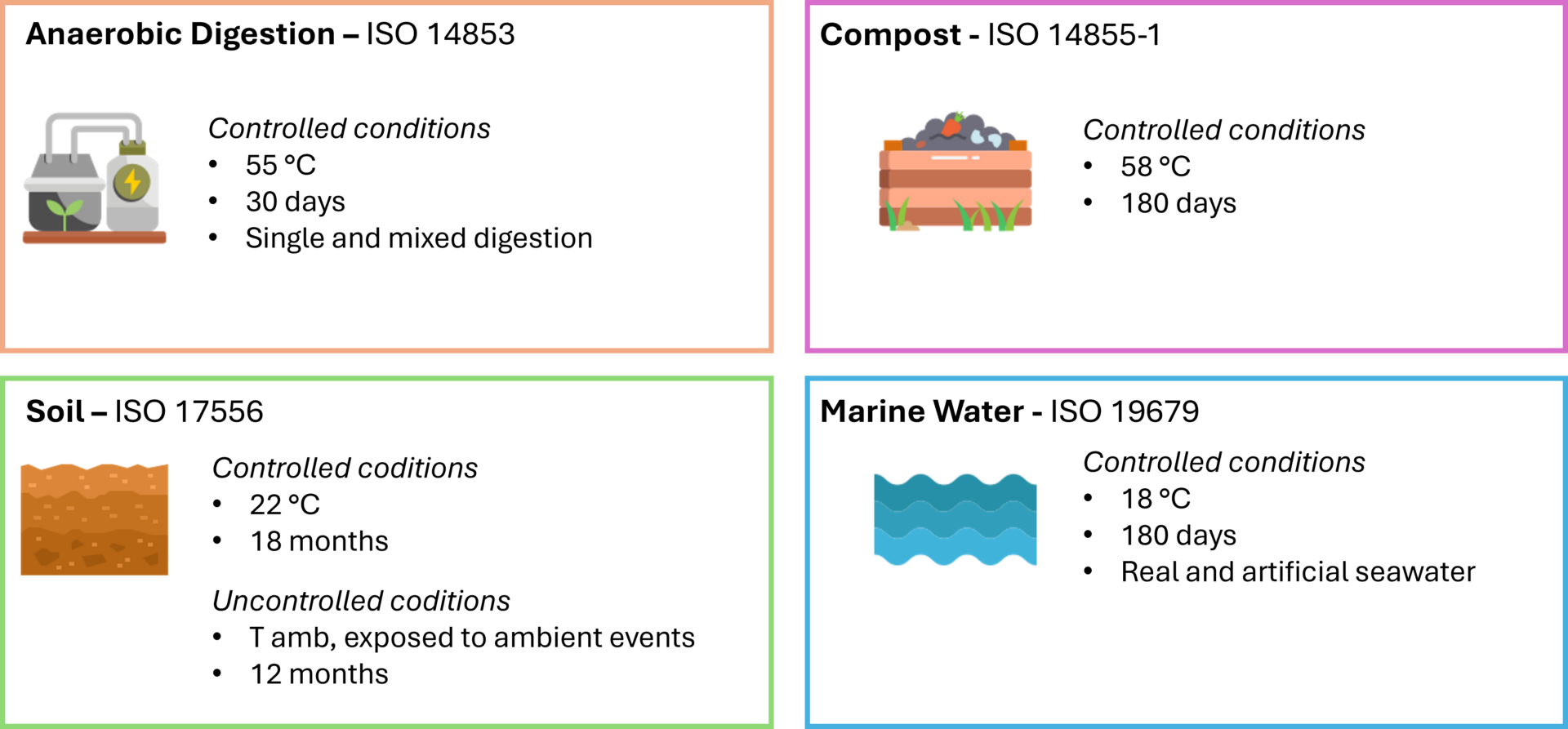
Return experimental design
The process was evaluated in terms of biogas/CO2 evolution (biodegradation degree), disintegration degree, chemical variations of residual bioplastics, release of micro-bioplastics and ecotoxic effects on model organisms and model plants.
The systematic assessment of bioplastics degradation in different environments showed that:
- Degradation behavior is strongly material-specific, depending primarily on the chemical nature of the polymeric matrix (e.g. biopolymer structure and crystallinity, additives nature);
- Digestate conditions are generally less favorable than composting for biodegradation and disintegration, so bioplastic products that perform well in industrial compost may persist in final digestate;
- Current standards and certification schemes may not fully capture real-world variability, as they are typically based on controlled test conditions and may not adequately represent the operational heterogeneity of full-scale plants;
- In uncontrolled natural environments, degradation is markedly slower, increasing the likelihood of persistence and dispersion; moreover, material breakdown and associated leachates can be linked to ecotoxicological signals (e.g., phytotoxicity) and changes in water chemistry (e.g., acidification), depending on the polymer type and environmental conditions.
While further assessments are required to draw robust and definitive conclusions, the present study provides a robust and systematic basis for understanding the environmental behavior of commercial bioplastics.
Developing sustainability: REPOXYBLE new composites and business models
Thermoset composites are a material that has been synthesised to possess a low density, and to be able to exhibit physical-chemical properties that are tailored for specific applications. These composites offer a high level of functionality and performance, even in extreme conditions, and can be used in a variety of industrial sectors. Because of these properties as well as heterogeneity of additives and overall composition, their recycling is difficult., They still end up in landfill or thermal utilization (e.g., annually EU recycle only an estimated 10% of the produced composites for aerospace, and an estimated 40% of automotive ones). New composites, designed accordingly to SSbD principles, promise to solve this problem, and enable a sustainable and circular transition.
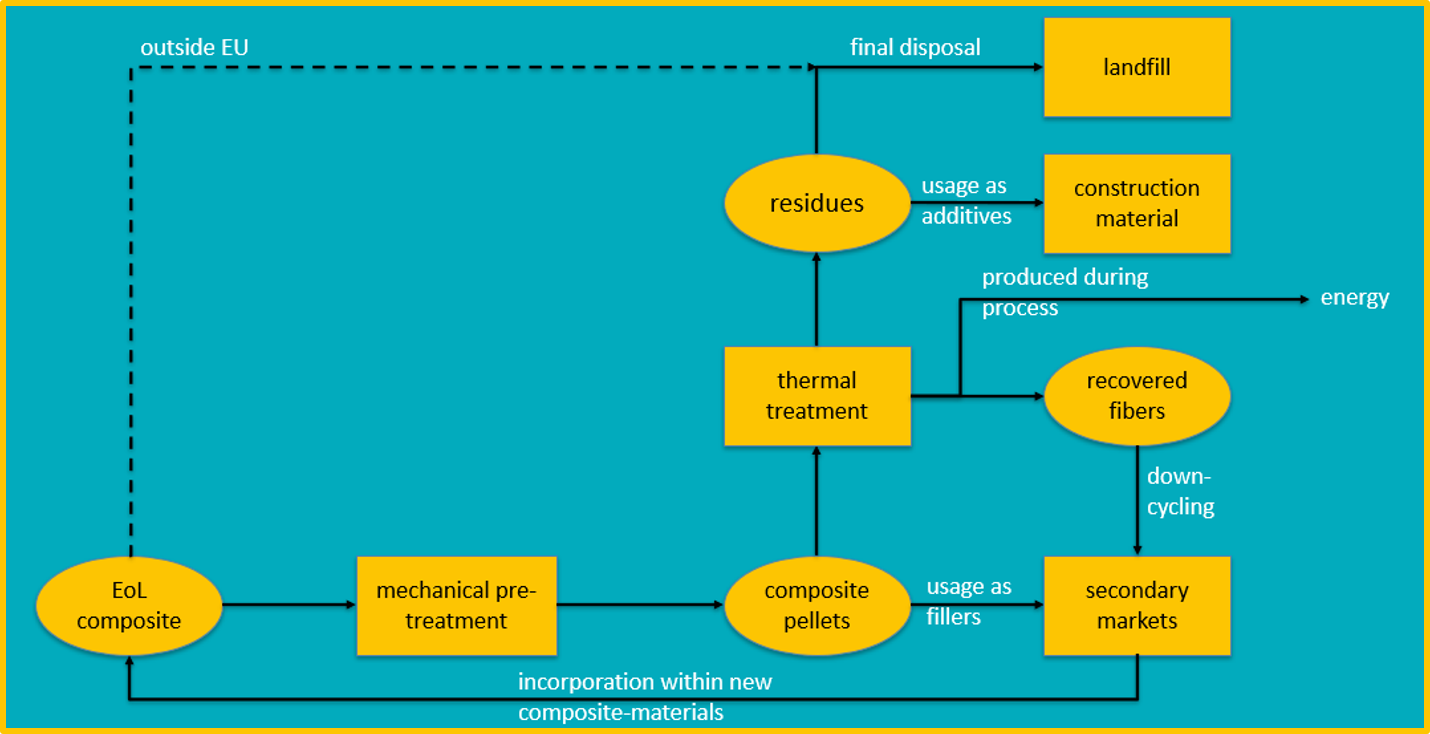
Current and new composite End of Life treatments
The REPOXYBLE project has progressed in this direction by developing new epoxy systems that exhibit advanced multifunctionalities and facilitate recycling. The SSbD framework has been applied, and research has been conducted into the economic feasibility of different applications. The depolymerizable epoxy resin system, based on a novel, cleavable hardeners, offer an alternative to current non-recyclable thermosets since reactive building blocks from the resin are recovered through solvolysis under ambient, aqueous acidic conditions.
The case studies for the application of the epoxy resin system within the REPOXYBLE project are structural and semi-structural automotive and aerospace components that are subject to particularly stringent requirements. These include rapid curing during the production process, utilization of lightweight, bio-based materials, the possession of high thermo-mechanical properties, the demonstration of multifunctionality, and the requirement of cost effectiveness. The REPOXYBLE composite system provides an alternative to alloy parts, meeting the stringent requirements while simultaneously offering more sustainability via recyclability.
The added value of REPOXYBLE composites is to enable high recyclability of components, maintaining their high-properties, and a high recyclability & reusability of the solvent used during the chemical recycling. Moreover, the project reached significant energy reduction in the production when applying additive assisted IR curing to the composite system and developed multiple new functional additives (reduced Graphene Oxide sheets, nanoparticles for increased curing efficiency, flame retardants).
However, new technologies alone are not sufficient to reach complete circular value chains: New business models are needed too. As an example, REPOXYBLE partner and automotive end-user RIVERSIMPLE do not sell cars but sell service contracts (pay-to-use, similar to leasing) instead. This means that car stays on company balance sheet till End of Life and implies the need to design the car and its components with maximum efficiency and maximum recovery of value. New business models require new technologies, and vice versa: research, industry and consumers need to shift towards a circular mentality.
Circularity and cooperation are the key to a competitive and sustainable industry
The final discussion confirmed the interest in new technologies to develop circular biobased plastics and composites, and in their characterization methods and protocols.
- The regulatory landscape was addressed as one of the main drivers to foster collection, recycling and reuse of composites materials. The role of policy makers in facilitating new circular value chains and to counterbalance higher costs or investments into new business models and technology is essential. For example, composites waste falls in the classification of glass or plastics, while should be considered on their own.
- Industry needs to apply new recycling technologies and adopt new circular business models to retrieve and reuse all their components, both from existing and novel materials: the designs of new composites and better recycling technologies for already existing composites go hand in hand.
- To strengthen this strategy and meet the needs of all the actors involved, cooperation and networking are fundamental: “Scientific community and industry can solve everything together, with a coordinate, constant effort”, “We really need all the technology as possible, and we’ll reach a greater impact sharing more contacts as possible with industries, networks, and projects” participants said.